Creative teams rarely stay the same size for long. Maybe you’ve added a new designer to handle a seasonal surge, or you’ve brought on a contractor to support a big campaign. Or maybe you’ve taken on new clients, and you need a quick, easy way to collect client feedback. As a result, how customers pay can change as your team and offerings evolve. Online proofing software that once worked for your three-person team suddenly isn’t cutting it for 10 or more.
A guide to pricing models for online proofing software: Are there scalable options for growing teams?
As your creative team grows, choosing a scalable pricing model ensures your online proofing software keeps pace without driving up unpredictable costs.

Meredith
6
min read
Feb 13, 2026
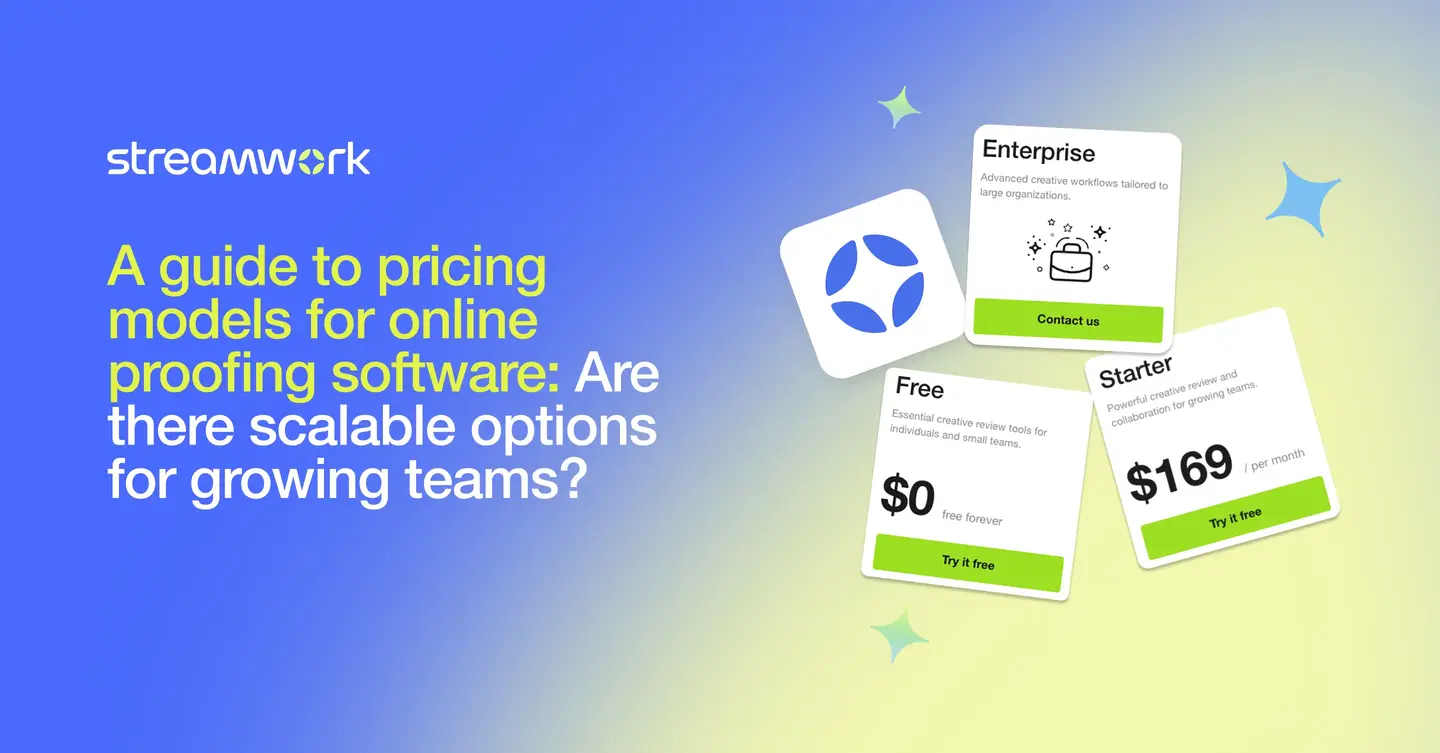
Project managers and creative directors need certainty around pricing structures — even when the size of their team is in flux. That’s why we’re going over the most common software pricing models and how to figure out the right pricing model for your business. Selecting among different pricing models helps align your software spend with your team’s growth needs. Whether you're a team of one or 100, your online proofing software needs to scale with you. For saas companies, choosing the right pricing strategy can make or break long‑term customer retention.
This Article Contains:
open
hide
The Most Common SaaS Pricing Models for Online Proofing Software
There are five common SaaS pricing models for online proofing software, and each has its pros and cons. Understanding software pricing strategies is crucial for planning predictable revenue.
1. Per-User Pricing Model
This is the most common software pricing model, where each internal team member who needs access is assigned a paid seat. Per-user pricing is simple to understand and budget for when teams are small, but costs can rise once you reach 10 or more users. Many SaaS vendors choose per‑user pricing because it directly ties usage to customer acquisition and recurring revenue. If seats cost $20 per user per month, for instance, a five‑person team would pay $100. To save on costs as your team grows, look for pricing packages that bundle seats, offering a set monthly or annual fee for, let’s say, 15 seats. Bundling seats into different pricing tiers can help teams scale without unexpected spikes in cost.
2. Flat-Rate Pricing Model
With flat‑rate pricing, you pay one fixed monthly cost regardless of your team’s size. These types of pricing plans are predictable and easy to forecast, but they may have higher upfront costs. With flat‑rate pricing, customers pay the same amount each period, which is simple for budgeting. They may also limit features or the number of active projects you can work on at once, depending on your plan. For a team of ten, flat‑rate pricing often sits in the same price range as per‑user pricing, but there are no penalties for adding freelancers or reviewers.
3. Tiered Pricing Model
With a tiered pricing model, more expensive pricing tiers unlock additional features, like advanced approvals, automations, and integrations. Tiered pricing lets you align price with perceived value as features add utility for different customer segments. The downside is that growing teams often need features found only at mid or upper tiers, making free versions or lower‑level tiers not as helpful.
4. Usage-Based Pricing Model
Ideal for low‑volume creative teams, usage‑based pricing means your team pays based on active projects, storage, or asset volume. One thing to keep in mind is that this SaaS pricing model can lead to unpredictable fees for agencies with fluctuating workloads. Because usage‑based billing tracks activity, customers pay in proportion to consumption. This can be appealing for teams that want flexible plans without fixed seat costs.
5. Hybrid or Value-Based Pricing Model
Most common in enterprise software, hybrid or value‑based pricing involves a mix of per‑set and volume limits. A flexible pricing model like this can balance predictable revenue with fair usage costs for customers. This software pricing model can be cost‑effective for large teams, but it’s often too complex for small to midsize agencies.
What Features Actually Justify Higher Pricing?
As your team scales, certain capabilities become essential rather than just optional. Here are a few features that may raise the price of online proofing software — but are actually worth the investment.
Advanced Markup Tools and Multi-Format Support
If you’re working with video, PDFs, presentations, or motion graphics, you need to find software that supports all of your file types. Moreover, reviewers should be able to mark up the files directly to keep feedback crystal clear. Tools that support premium features like advanced markup and multi‑format previews often justify higher costs because they reduce rework and speed review cycles.
Multi-Stage Approval Workflows
It’s not usually a straight shot from designer to client. Instead, assets need to be passed through multiple reviewers, including branding and legal departments. More sophisticated pricing often includes advanced workflow automation because it boosts customer lifetime value by increasing usage and stickiness. Automated multi‑stage approval workflows can save loads of time in comparison to manually routing assets from one department to another.
Bulk Approval Workflows
Teams that work on a high volume of content across tight deadlines need the ability to route multiple assets at once for review and approval. Only a few of the top online proofing solutions offer bulk approvals, so if this is something your team needs to keep the creative process flowing, make sure it’s included in the platform you select. When customers pay for functionality used every day, it reduces friction and increases satisfaction.
Integrations With Project Management and Creative Tools
Your online proofing software needs to play nice with the tools you already use — likely some combination of Asana, Monday.com, Slack, Google Drive, Dropbox, and Adobe Creative Cloud. Integrations reduce the manual work of updating multiple systems to save time and cut down on errors. Strong integration capabilities can be a selling point in common software pricing models, as customers see immediate workflow improvements. Integrations also make it easier to roll out online proofing software across your organization because there is minimal change management involved.
Audit Trails and Compliance
For teams working in regulated industries or with enterprise clients, documentation is a must. Software with built-in approval logs, including granular dashboards and deadlines, helps create a clear audit trail so you stay safe and compliant. Because compliance features are valuable to enterprise customer segments, they often appear only in higher pricing tiers.
Version Control
As you’ve probably experienced once or twice before, naming a file “final_final_v9” isn’t the way. Version control eliminates naming chaos and keeps everyone working on the latest file, a worthwhile investment for growing teams. Most project management platforms do not offer version control or management, so it’s a major plus to integrate with an online proofing solution that does. Version control also increases perceived value by reducing errors and confusion.
Unlimited External Reviewers
Many software pricing models charge extra for each user outside of your organization. If you’re working with multiple clients and contractors, that can add up quickly. Look for online proofing software that lets you share projects and files with an unlimited number of guest reviewers at no cost to save significantly. Plans that allow free external reviewers improve customer acquisition cost efficiency for agencies.
The good news? As a top online proofing platform, StreamWork is equipped with all of these features to provide you with the greatest return on your investment as your team grows.
Choosing the Right Pricing Model for Your Team of 10
Every organization is different, so we’ve put together a sort of quick-start guide on finding the right pricing model for you.
If your team collaborates with many external reviewers…
Prioritize options with unlimited guest access so you avoid per-seat charges for clients and contractors.
If your team fluctuates seasonally…
Avoid rigid per-seat models and look for platforms that allow flexible seat allocation.
If you anticipate rapid hiring…
Choose a software pricing model with predictable monthly or annual seat pricing to keep budgets stable.
If advanced workflow automation matters…
Select from pricing tiers that include integrations, especially if you already use Asana or Monday.com.
If cost forecasting is critical…
Compare annual versus monthly pricing. Annual contracts can often reduce costs by 15-20% and make long-term budgeting easier.
Scalable SaaS Pricing Exists. You Just Need the Right Model.
Online proofing platforms vary widely in how they charge, and teams benefit most from predictable, scalable pricing structures. StreamWork stands out thanks to its flexible pricing plans, which include:
- Free pricing plans for individuals and two-person teams — It’s perfect for freelancers, microteams, or organizations testing online proofing for the first time.
- A paid seat model for internal team members — StreamWork scales cleanly from three to 50 employees, and you pay only for internal contributors.
- Unlimited free guest reviewers — Give access to as many freelancers, clients, and external stakeholders as you need for free, a major cost-saver for agencies.
- Predictable upgrade path — With clear pricing and no hidden fees, StreamWork’s higher pricing tiers include integrations with Asana, Monday.com, Slack, Adobe Creative Cloud, and more.
- Fourteen-day free trial with no credit card — Test workflows, compare features, and evaluate value-per-dollar before committing.
As your creative team grows, it’s important to evaluate pricing structures based on your current and future needs — not just on today’s team size. StreamWork makes choosing the right pricing model flexible and transparent. Ready to see how StreamWork can scale with your team? Give it a try for free.

Author
Meredith
Meredith is the Founder and CEO of StreamWork, a leading online proofing and approval platform that helps marketing and creative teams centralize feedback, manage versions and automate approval workflows so they can cut approval cycles by 30%+. Meredith has 12+ years experience working as a marketer at Apple, Google, YouTube and Warner Bros., and has worked on hundreds of creative assets with teams large and small. Her mission is to simplify the creative approval process. Learn more at www.streamwork.com
Collaboration
Marketing excellence
This is some text inside of a div block.
Get the latest from StreamWork
Stay up to date on product news, insights, thought leadership and more.